

As the holidays draw to a close, decorations start coming down (mine stay up until January 6, but you do you), seasonal playlists return to their li’l media caves or whatever to be pulled up again eleven months from now, and stretchy waistbands start quietly weeping for relief, we can certainly make two observations.
1. Love, Actually is not a good movie.
2. Love, Actually is a much-beloved holiday classic.
And 22 years after its release, it doesn’t seem like Love, Actually should be a significant topic of conversation, but it is. Every year brings revived discussions about the sweet and/or creepy and/or unrealistic storylines, the parts that do or don’t hold up to the passage of time, and takes ranging from the dismissive to the defensive to the derisive to the super-duper pressed.
(But for real, though, what would Mark have done if Peter had answered the door instead of Juliet? Try and play it off and pledge eternal love to his best friend via cue card?)
And having read all the hottest of Love, Actually takes of this holiday season, I can comfortably say they’re all right. Yes, it’s a romantic movie. Yes, it’s a bad movie. Yes, the cue card thing is super creepy, and many of the storylines are full-on inappropriate. Yes, it’s sweet, and also wrong.
Yes, despite all that, it’s a beloved-by-many holiday classic, and why is that?
Well, let’s take a look at it in the harsh light of January, without a blur of twinkle lights and spiked eggnog fogging our vision.
Of course it’s not good.
Note: None of the following applies to Dame Emma Thompson’s silent breakdown scene after Karen discovers Harry’s emotional infidelity, which was out-of-scale, is-this-a-different-movie devastating.
I mean, look at it. It’s not going to be good.
Love, Actually is a two-hour movie that follows nine storylines-of-love that include office romances, friendships, familial relationships, a failing marriage, and an absolutely bonkers wish-fulfillment international boinkfest. It’s not going to have time to do healthy-relationship justice to each couple — Jamie and Aurelia actually getting to know each other in the epilogue now that they share a common language, moments during the David/Natalie subplot that would demonstrate a greater connection than pure physical attraction, Karen and Harry doing the work to rescue their marriage — without turning a holiday romp into a miniseries.
It is an expected standard across Romancelandia that a true romance has to have a happily-ever-after. It can have romantic elements to it, it can be a love story, but if it doesn’t end with an HEA, it’s something other than an actual romance novel. So by that standard, if Richard Curtis wants to make a rom-com that’s as much rom as com, he’s obligated to include the meet-cute and the HEA, and anything he can fit in between the two is gravy. Nine storylines doesn’t leave room for a lot of gravy, thus some seriously underdeveloped arcs we’re expected to accept as romantic because “love” is in the title, which people obligingly do.
Does all that a high art film make? Of course it doesn’t. And that’s a choice Curtis made. He thought, consciously or subconsciously, “Screw it, we’re going for quantity over quality,” and clown-carred those subplots right on in. If you read Love, Actually’s blurb and went into it expecting Marriage Story, The Proposal, My Best Friend’s Wedding, and About a Boy all crammed into two hours and fifteen minutes, I’m going to have to say that’s on you for being a very silly person.
No, it definitely doesn’t hold up over time.
Sweet fluffiness aside, a number of aspects of the film draw a cringe from even the most loyal Love, Actually stans. Some storylines that got a chuckle and a pass back in 2003 do not hold up to the cultural values of 2025.
Three of the storylines involve an employer and his (much younger) employee, two of which lead to those crucial HAEs. One of the storylines involves a man quasi-stalking his best friend’s girlfriend/wife and then declaring his love to her in front of the home she shares with her husband via elaborately designed cue cards. And from a personal perspective, I will note that on first watch, when we were introduced to Natalie, I thought, “Holy crap, it’s a female romantic lead who’s allowed to be beautiful while having a body that’s shaped like mine,” only for her to almost instantly be deemed a fatty-fat-fat by the willowiest willow ever to willow, so… thanks, Rich. And we can point to a vast lack of diversity in a movie set in, y’know, London.
Those are things that don’t line up with 2025 values — hell, some of them didn’t even line up with 2003 values and were problematic then just as they’re problematic now. And that’s its own debate. A lot of media from the Olden Days remains in current circulation despite conveying values that would range from outdated to abhorrent today. Do you discard it because its values don’t fit with the values of today? Do you give it a pass because it fit with the values of its time and can’t be expected to hold up to the values of today? Do you have a more nuanced take? My name’s Paul, and that shit’s between you and your personal ethic — it falls into a much larger, more culturally significant conversation that I’m personally ill-equipped to steward here. But I’m not about to say it doesn’t matter.
It is often adorable.
Things that are objectively adorable, sweet, and/or hilarious, because I say they are, in no particular order:
– The non-romantic-love storylines between Daniel and his stepson Sam and Billy and his manager Joe
– Daniel’s platonic grownup friendship with Karen — underappreciated by the viewing public, I feel
– Emma Thompson’s aforementioned breakdown scene, but also Gregor Fisher’s quiet resignation as the much-beleaguered Joe
– Thomas Brodie-Sangster’s worried-puppy eyes during the entire film

– The sweet, actually substantive romantic relationship growing between Jack and Just Judy as they dry-humped away on the set of what Richard Curtis swears was a classy-but-explicit kind of non-adult film
– David’s police escort’s nonchalant, operatic “Good King Wenceslas”
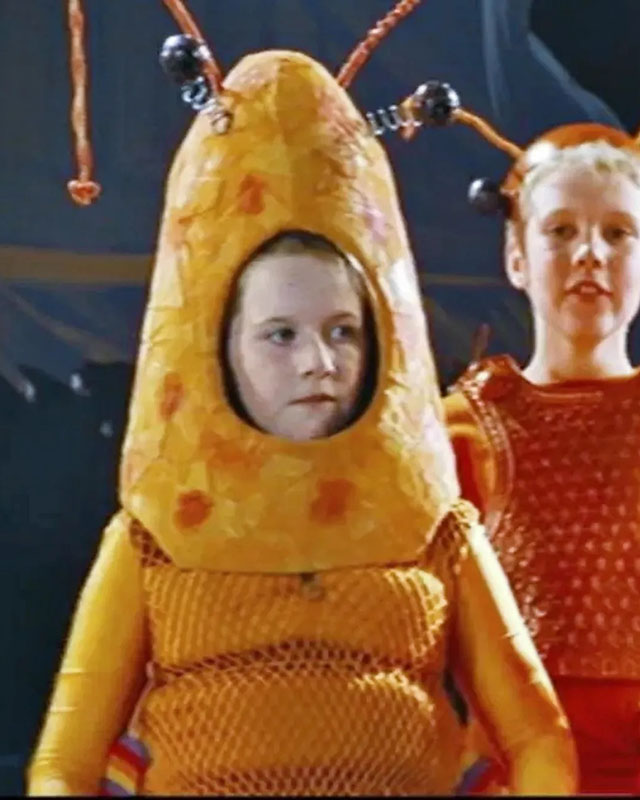
– The enormous octopus costume, and the fact that if David hadn’t shown up with his motorcade, the kid would have just walked to the school wearing it
– The absolute, unabashed, egregious ridiculousness of Colin’s storyline in Fantastic Wisconsin, which realistically should be offensive but was so completely over the top as to be just short of lampshading
– London At Christmastime porn
People like it because people don’t always like good things.
Despite its flaws, why does Love, Actually remain a holiday classic for millions of people?
It’s because sometimes, people like bad movies. They like movies with simple plots that don’t make you think, and ones they’ve seen a hundred times already so they know what to expect and won’t be surprised by anything. And that’s fine. Aforementioned sociocultural issues aside, it is okay to enjoy poor-quality media. It’s okay, in general, to like stuff that isn’t good for you.
And the holidays in particular are a time when we embrace things that have no redeeming value other than they taste good. We gorge on cookies and candy. We booze it up. We snack from charcuterie boards that are actively trying to give us a heart attack. There are healthy things — even the most gratuitous of Christmas dinners usually at least include a few vegetables, and the gift-exchanging process evokes the joy of giving as much as the joy of receiving. At the holidays, we let ourselves embrace both, often with less guilt than we might otherwise experience. And then we put away the chocolate oranges and the standing rib roast and the Heartwarming Holiday Romps until next December, because it’s only special if it’s special and because the human pancreas can only take so much.
Am I saying such gratuitous bingeing is a good thing? Arguably no. I came back from Christmas at my parents’ house toting seven extra pounds of weight and a sauvignon blanc-pickled liver, and I’m sure my blood type is currently Gravy. Overconsumption of neither festive foods nor festive media of marginal value is an overall good thing. But within an otherwise healthy diet, the occasional hit of dopamine from an extra cooke (or three) or a silly but satisfying movie is generally an innocuous li’l treat. And part of both health literacy and media literacy is being able to recognize what’s good, beneficial nourishment and what’s just sweet, tasty, low-impact crap.
And thus.
Don’t go around thinking this is an example of great cinema. Don’t attempt any of the things presented in the movie as examples of grand romantic gestures, because they do not hold up to real life. Don’t feel like a buzzkill for disliking it for its problematic elements, because yikes. Don’t hate yourself for knowing, in your heart of hearts, that the movie is kind of crappy but loving it anyway. Because here’s the thing:
It’s all stupid and it doesn’t matter.
I hope you all had a very merry holiday season and a happy and safe New Year’s Eve/Day, and I wish you all the best as 2026 lies before us like fresh, un-peed-upon snow. Love y’all. Happy new year!