
The men’s World Cup is coming to an end — Spain will be facing off against Argentina in the final on Sunday — and that’s a special occasion for the maintenance team at MetLife Stadium, who will finally be able to uncover sponsor logos and even the name of the stadium itself that have been concealed for the past month and a half.
And that’s because under FIFA’s “clean stadium” policy, every men’s World Cup venue has had to hide their own sponsor branding, including the name of the stadium if necessary, to create a blank branding slate for FIFA’s sponsors.
It sounds like a lot, but it is a FIFA event, and they get to make the rules. Sponsors pay millions of dollars for brand deals with FIFA, and they don’t want their logos lost amid a sea of other brands getting that visibility for free. Grounds crews at venues have had to put in considerable work to make sure very sponsor name and logo became invisible, and now they get to put further work into undoing that.
Here are some venues that really did the job rolling out the blank carpet for FIFA’s sponsors.
“New York New Jersey” (MetLife) Stadium
MetLife Stadium in Not Actually New York did push back on one FIFA demand: covering the MetLife logo on every cupholder in the stadium. Their argument was that covering up the logo at nearly 80,000 seats using union labor would be astronomically expensive, and FIFA doesn’t have an insurance brand they’d be competing with, and… checks out. FIFA gave them a pass.
More interesting than the cupholders is the slapfight between New York and New Jersey, which apparently didn’t nail down, when they decided to go halvsies on bringing the men’s World Cup to the Meadowlands, whose name would go first on the stadium. FIFA defaulted to New York New Jersey, but New Jersey’s governor insisted that one of the two signs outside the stadium declare it New Jersey New York, and both governors have been super passive-aggressive about the whole thing the whole time.
“San Francisco Bay Area” (Levi’s) Stadium
When Levi’s rebranded its stadium to the rolls-off-the-tongue San Francisco Bay Area Stadium, they went so far as to cover the brand name on the ketchup bottles in the press box to make sure no accidental branding snuck through. But it was their to-the-letter obedience of FIFA’s policy that drew attention.
They absolutely, 100% covered up the name of the stadium as instructed. And if a certain iconic shape might have remained wholly apparent?
Not something they could have helped. Levi’s took advantage of the change by using its newly masked logo all social media and draping storefronts in major cities around the world.
“Boston” (Gillette) Stadium
White NYNJNY Stadium pushed back against 100% de-branding, Gillette didn’t have the same option. With Unilever’s big brand deal with FIFA, Gillette wasn’t sneaking in for free and, for the duration of the games, had to remove or cover all existing branding, right down to little blue stickers on all 64,146 seats to cover up the Gillette logo.
Like Levi’s, though, they took a clever approach to de-branding by covering their stadium name in a giant layer of shaving cream.
(It’s pretend shaving cream. The real stuff would be prohibitively expansive.)
You can make them hide their stadium name, FIFA, but you can’t make them like it.
“Field” (Lumen Field)
(OK, “Seattle Stadium”)
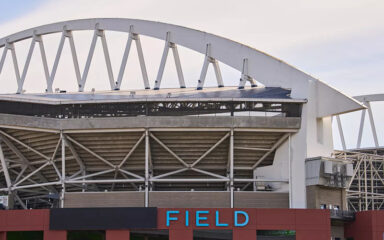
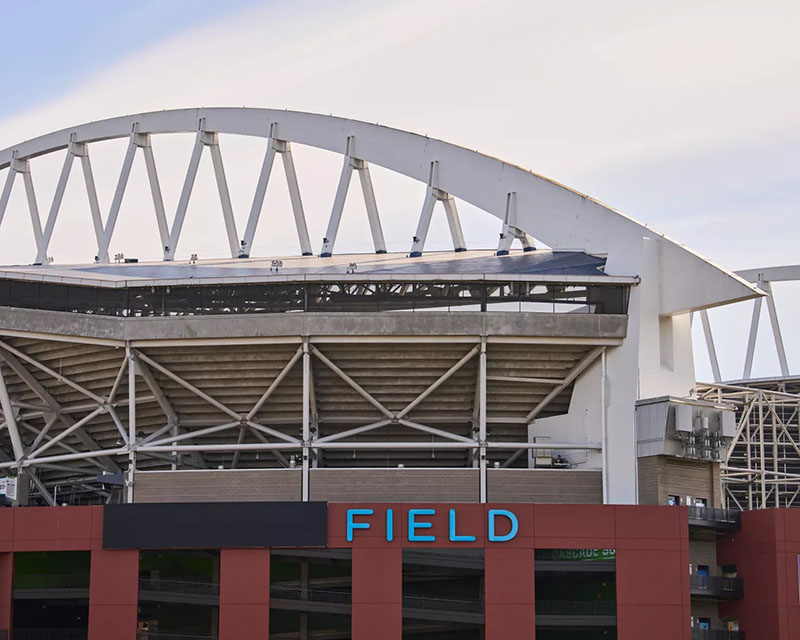
In direct contrast to the heroic efforts made by other stadiums is Seattle’s Lumen Field, which phoned it in basically as much as a stadium could without getting (football) booted by FIFA. For all that they made a big deal out of their de-branding process, the final results were less than inspiring, covering the twin logos on its roof with what appears to be trash bags and painter’s tape. Nor did they do anything beyond the bare minimum in blacking out the logo on the front but not putting anything else there, leaving it just… “Field.”
“Dallas” (AT&T) Stadium
The crew at no-longer-Dallas Stadium wasted no time in returning to its original AT&T branding — barely 12 hours after Spain finished beating France in Tuesday’s semifinals, workers were all over the stadium, uncovering the name.
One change that will take a little longer: In preparation for tender soccer feetsies, the stadium had to swap out the Cowboys’ usual artificial turf for real grass, a Kentucky bluegrass and ryegrass mix trucked in 800 miles from Colorado, to give the players a cushy surface to land on when they dramatically threw themselves to the ground. Plus install grow lights and a special ventilation and irrigation system to keep the grass alive under the closed stadium dome. All of which is now coming right back up in preparation for the upcoming real-football season. So… that’s cool.
Mercedes-Benz YEAH I SAID IT Stadium
The only exception to FIFA’s de-branding rule was Atlanta Stadium, which remained Mercedes-Benz Stadium just a little bit because the genuinely enormous Mercedes logo on the retractable roof would just be too hard to cover without causing damage. So while assorted logos in and around the stadium did have to go, the most prominent branding remained, you heard the ATLiens, back the hell up off them.
@atlantadroneguy 🏆⚽ Atlanta will host 8 FIFA World Cup 2026 matches, including a Semi-Final. 📍 Mercedes-Benz Stadium June 15 • June 18 • June 21 • June 24 • June 27 • July 1 • July 7 • July 15 The world is coming to Atlanta. 🌎🔥 #Atlanta #FIFAWorldCup #WorldCup2026 #atlantadroneguy ♬ original sound – Atlanta Drone Guy
And so with the men’s World Cup mostly in the rearview mirror and un-de-branding underway all over the continent, we can return to that most precious of observations: anticipation of the return of for-real football in September. This year, the NFL season kicks off with the Seattle Seahawks taking on the New England Patriots at…
I don’t know. It just says “Field.” I’ll get back to you with more information on that.