

I’ve written in the past about tips for writer’s block a la creative copywriters — that particular varietal of writer who does get writer’s block but doesn’t have the luxury of putting it away and trying again tomorrow as some other writers, those with less-rapid turnaround, often do.
But, the brilliance of those suggestions notwithstanding, that doesn’t mean none of the classics are worth exploring. The oldies-but-goodies are, by definition, as good as they are old. But that doesn’t mean they can’t benefit from a little refreshing, and particularly when you find yourself in the throes of the kind of writer’s block that defies description, some somewhat sterner stuff is called for.
So here are some of those more classic tips, with an added twist in case the standardly googleable ones aren’t getting the job done anymore.
Good: Do something else.
Better: Do something else using your hands.
(Be cool.) Doing the dishes, brushing your teeth, knotting a friendship bracelet, de-matting a dog, just something that uses your hands and at least a fraction of your attention. The activities will render you unable to type, of course, but that’s part of the point — it gets you away from the all-terrible blank page and the anxiety that comes with it.
A nice walk during the day is nice, but if you’re like, for instance, me, that’s just an opportunity to stress out and overthink whilst outside. There’s a sweet spot where you can occupy just enough of your brain to apply whatever’s left to creativity. It’s different for everyone, so maybe pick up a small assortment of embroidery floss from somewhere and start tying.
Good: Write it out by hand.
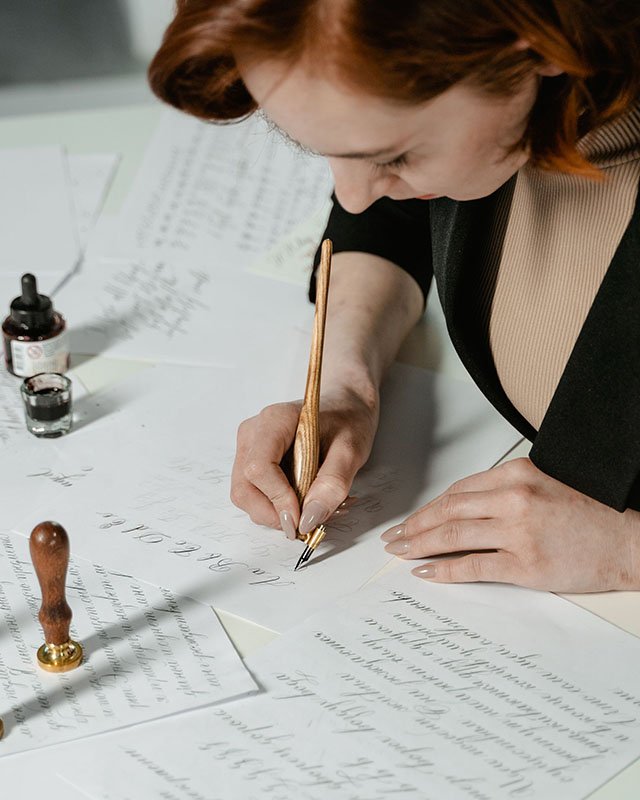
Better: Write it out in calligraphy.
This is a good option if you don’t have any dirty dishes or embroidery floss, and if you’re the kind of person who likes writing things by hand and finds it to be a helpful for brainstorming and/or first-drafting. It just cranks the handwriting part of it up to 11, shifting even more of the attention from your brain to your hand where it can, at the moment, do you more good.
It doesn’t have to be fancy calligraphy-pen calligraphy. You can buy fancy pens if you want, or just get fancy with the pen you usually use — the point is to get the ideas down where you can see them but, since you’re having to attend to form as well as function, not obsess over them. I have poor fine motor control and can draw neither a straight nor, it turns out, a curved line, but even I can make it look marginally pretty, while also of serviceable quality.
Good: Bounce it off someone.
Better: Bounce it off your pet.
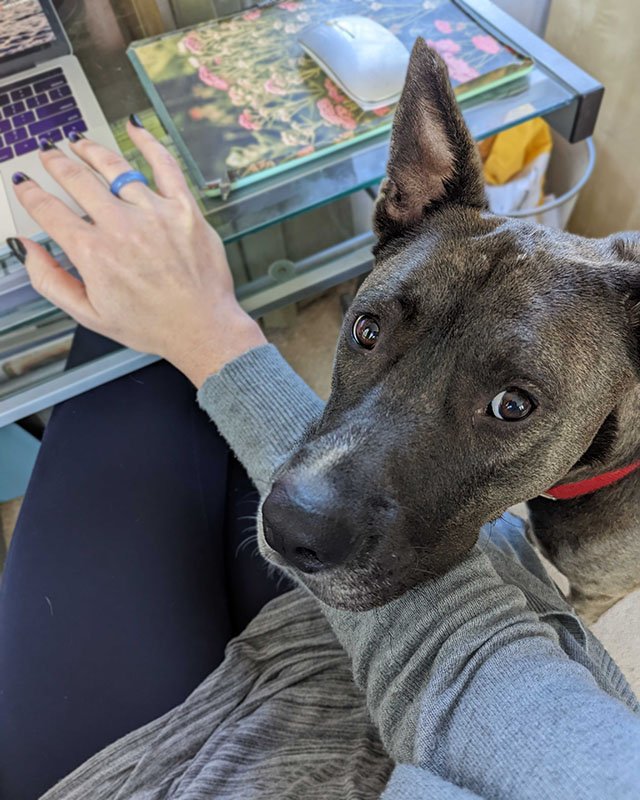
(Necessary equipment: Pet.)
Read it aloud to your pet. Clock their reaction. Talk it out with them. If you find yourself defending your copy to Fluffykins, it’s probably worth developing, even if you don’t realize it. If your pet, who may understand some English but probably not the nuances of an effective headline, has a reaction you disagree with, it’s probably not their opinion that’s getting your back up. So talk it over with them and listen to the arguments you’re making to… yourself.
Dogs are good for a variety of feedback. Cats are good if you’re a masochist who only wants to be silently disapproved of. My betta fish used to alternately ignore me and challenge me to fight. I can’t speak for any other kinds of pets — let me know if you have experience in that area.
Good: Think about it in the car.
Better: Talk about it in the car.
This is one to avoid during heavy traffic or when you’re tired (in which case you probably shouldn’t be driving anyway, btw). Safety first.
Monologue. Eyes on the road, hands at ten and two, but if you’ve got a commute or a solo road trip, this is, in my opinion, a superior option to just thinking about it, and for two reasons. One is that speaking out loud uses your brain differently. It forces you to organize your thoughts instead of just letting them spin around in there, and it better engages your prefrontal cortex and brings in areas of your brain not involved in silent thinking.
And from a safety standpoint, trying to scrawl notes against your steering wheel, or type on your laptop in the passenger seat, is unacceptable. A voice note will catch all the good spoken-aloud ideas with less danger to yourself and others.
Good: Let yourself write badly.
Better: Force yourself to write badly.
(Y’all know I appreciate the value of bad writing.) Sometimes, when your brain is stalled, the best thing to do is push it down a hill and try to pop it into second gear like a recalcitrant 1982 Honda Accord (RIP). And that might involve not just giving yourself the freedom to write badly, to put down whatever weak-ass copy comes to mind, but to give yourself the mandate of writing badly. The worst ideas. The worst phrases. Stuff to very carefully remove before sending it to the client.
This is immersion therapy for your fear of writing badly — you’re going to write badly. And when you get to the point where you’re struggling to come up with things to write badly, and the good stuff won’t stop sneaking through? Congratulations! You’ve conquered the blank-page problem, you have some bad ideas that might could be refinable, and you’ve demonstrated to yourself that putting not-great copy on the page won’t get you strangled by the angry ghost of David Ogilvy.
Good: Luck
No matter what kind of writing you write, writer’s block can be a beast, and I hope at least a few of these tips are useful in overcoming it. Just remember that road safety comes above all else, calligraphy can become a fun hobby, and writing badly can be even more fun if you really put your back into it. And if you need to borrow a pet to bounce ideas off of, Bentley is all ears (probably 80%, technically — there’s a story) and will be happy to gaze at you attentively as you get your copy hashed out.