
Why is the U.S. one of the only two countries in the entire world that allow D2C prescription drug advertising? Probably because it takes a very specific balance of healthcare needs and late-stage capitalism to decide that pressuring patients into asking their doctor for expensive name-brand medication they might not even benefit from and might not be able to afford without patient assistance they might not be eligible to get is awesome as long as you do it with a musical number.
(And I say this with the greatest of affection as a person who really hopes she didn’t just screw herself out of any future freelance work for pharma clients, please, I swear I have no scruples and will take your money.)
All that said, without D2C drug ads, we wouldn’t have some of the most bizarrely entertaining tropes in our industry. And I’m not talking about farmer’s market flash mobs and random bathtubs in a field. I’m talking about the most encyclopedic list of horrendous side effective imaginable recited over perky royalty-free music while an elderly couple rides fixies through a flower meadow, and warnings to tell my doctor about side effects that would definitely already have me on the way to the hospital.
Here are five recurring tropes that make drug advertising so darn special.
In the “every warning label has a story” category:
Tell your doctor if you have blurred vision or a parasitic infection.
Are parasitic infections a side effect of Dupixent? No. Has parasitic infection been associated with Dupixent use? Apparently, at least with enough frequency that they felt the need to mention it, which in this case means about one tenth of one percent of patients. Should our biggest concern be that people might start experiencing abruptly blurred vision or a parasitic infection and think, “Nah, this seems fine,” if not advised to do so by a TV commercial? I vote yes.
Do not use this drug if you’re allergic to this drug.
REALLY. WOW. That explains why I keep running out of EpiPens and know all the EMTs in the area by name. Now talk with me about why I keep getting hives when I eat strawberries, and whether it has anything to do with my strawberry allergy.
Seriously, though, they wouldn’t cram it into their very limited runtime if it wasn’t actually a thing that happened, meaning there probably have been visits where the doctor and patient are discussing adding Repatha to their statin and neither mused, “Hey, aren’t you actually allergic to Repatha?”
In the “kill or cure” category:
This drug may increase risk of a different version of the same condition.
I don’t pretend to be a doctor, and I’m certainly not going to try and get into a debate about the relative merits and challenges of dry vs. wet AMD. From a layperson’s perspective, though, it’s hard not to notice an ad mentioning that severe side effects of a drug can include a worse version of the condition you already have.
Common side effects include your skin turning red and peeling from your body.
No more plaque psoriasis — just redness, itching, swelling, burning, stinging, application site pain, inflamed hair follicles, skin thinning, peeling, and rash.
In the “numbers game” category:
If you have HR+ HER2- metastatic breast cancer…
Fun math: About 120,000 people in the U.S. have that specific kind of cancer. If Pfizer is going to drop $200k on 0:60 broadcast ad space, that means they’re spending $1.66 per patient to try to talk them into taking Ibrance, and it strikes me that D2C advertising in this case might not be as efficient as throwing a couple more pens and branded Post-Its at oncologists.
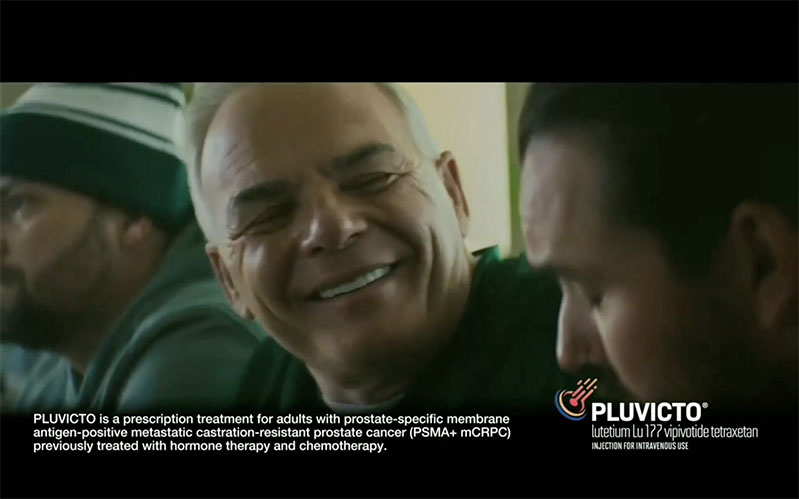
If you have PSMA+ mCRPC prostate cancer that hasn’t responded to hormone therapy or chemotherapy…
At some point, your best budget bet is just going to be, “Hey, Keith. Keith Watkins, Saratoga Springs. Yeah, hi. Talk to Dr. Woodson about Pluvicto.”
In the “how about you tell me if I have cancer” category:
Tell your doctor if you have cancer.
… Your doctor should know. If you have cancer, your doctor should definitely know about it, and if you’re sitting around thinking, “I should tell Dr. So-and-So about my CANCER while we’re discussing this drug,” you have the WRONG DOCTOR. Whether or not you’d benefit from whatever drug is being shilled to you, I hereby Rx you A DIFFERENT DOCTOR.
Stay healthy, y’all.
And if you’re worried that reading my blog might lead to redness, itching, swelling, burning, stinging, application site pain, inflamed hair follicles, skin thinning, peeling, rash, nausea, restlessness, fatigue, flulike symptoms, weight loss, weight gain, hypertension, depression, anxiety, dizziness, sleepiness, swelling of the tongue or throat, headache, diarrhea, sexual dysfunction, and wet AMD…
I wouldn’t worry about it. Stress isn’t good for you.